How to get a horse who stays out of your space, walks, stops and backs up with you, with the lightest possible ask.
No power struggle. A space you can see, four levels of ask, and a release the moment the horse responds. On a lead rope, in everyday life.
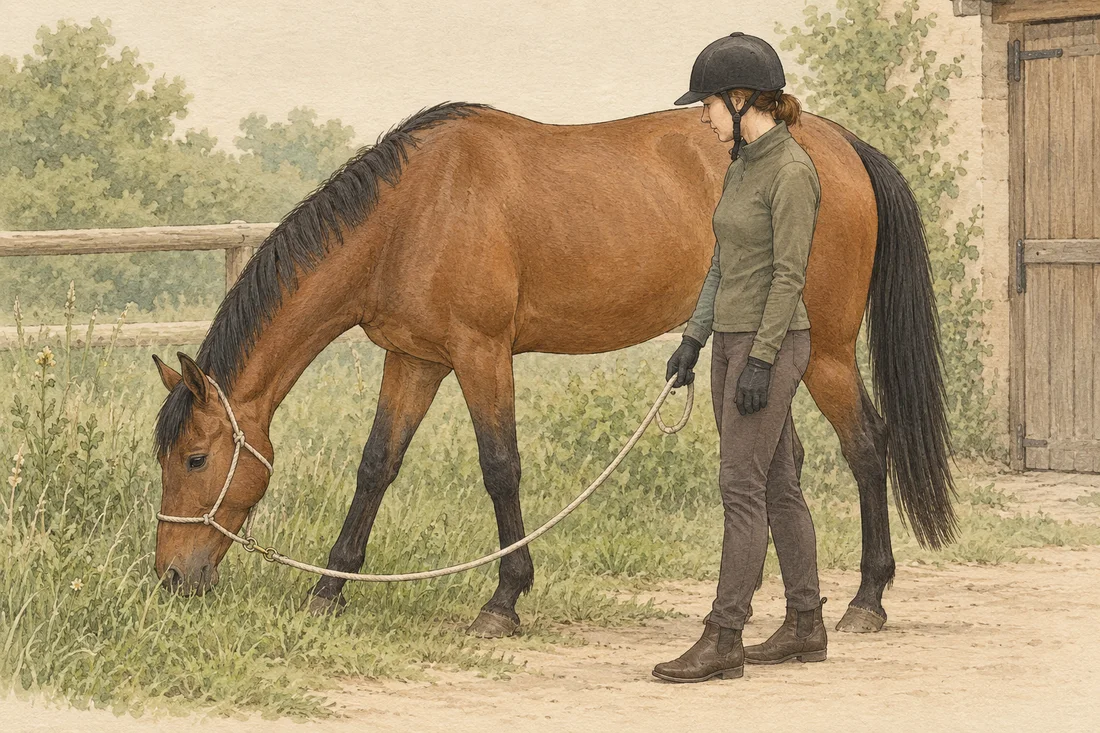
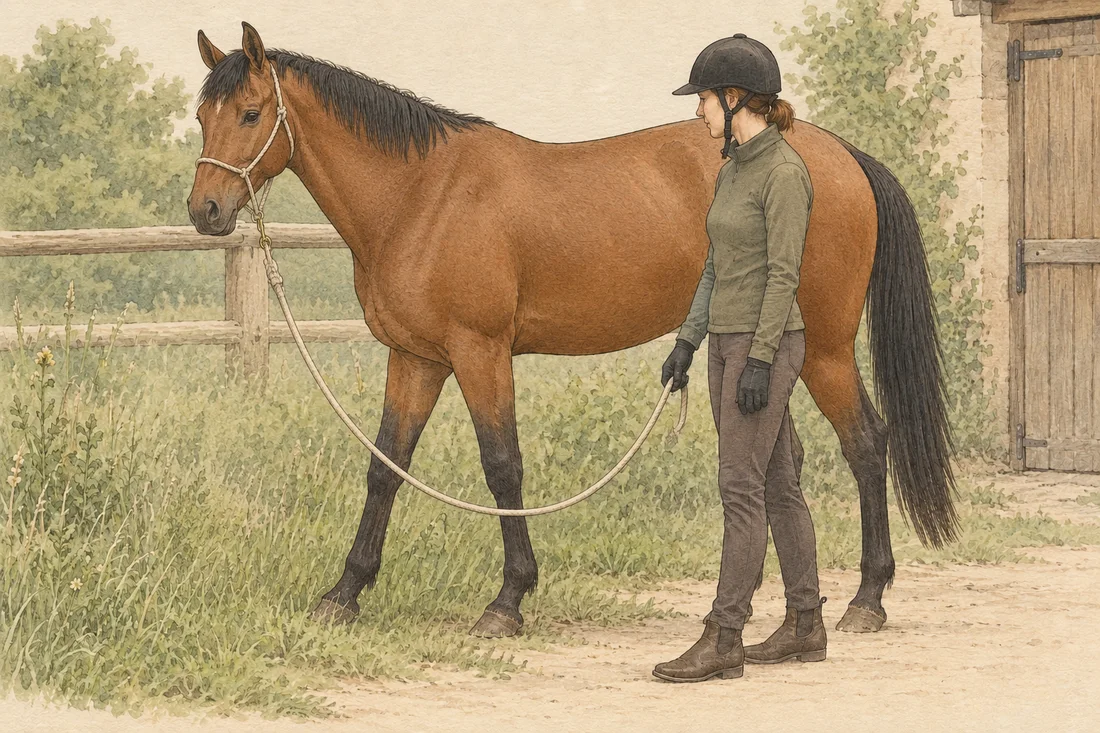
The same path, the same horse. The difference is the ask, and the moment it stops.
Keep reading if you want to:
- Know where your space begins, and see the horse's shoulder coming toward it before it touches you.
- Ask him to move away, walk on, stop or back up, starting with a simple look.
- Stop the ask the instant he responds, instead of insisting until everyone tenses up.
- Get through the stall door, the tie spot, the pasture gate and the puddle on the path with the same gestures.
- Move his shoulders and his hindquarters, on both sides, without pulling or pushing.
- Go over all of it in ten minutes on the ground, in a set order, before you ride or instead of riding.
From: Louise Ferrand
Riding instructor and author of The Saddle Method collection.
If your horse pushes into you, drags you toward the grass or will not move, this page is for you
You lead him from the pasture to his stall. He gets ahead of you, his shoulder comes closer to yours, then he dives for the grass at the edge of the path. You pull, he pulls harder. At the stall door, he goes in before you.
You may have been told that he “doesn't respect you.” That is true, but it does not tell you what to do. And the advice you find often talks about power struggles.
This book offers something else: a definition of respect you can see, and asks that always start with the lightest one.
What “respect” means here
The word in the title means two things you can see. First, the horse stays out of your space until you invite him in. Second, he moves when you ask, with the lightest possible ask.
Nothing more. No intention to guess, no character to judge. You look at where his feet are, where his head is, and at which level he responded.
I teach groundwork as a quiet conversation: a light ask, an answer, and silence right after.
With a horse who pushes into you on the ground, you have two options
Option #1 teaches the horse that the ask never stops. Option #2 teaches him that the smallest response is enough.
That is what the first two parts of the book set up, before anything else.
The Saddle Method: the bubble, the four levels, the release
The whole book rests on three words:
In practice:
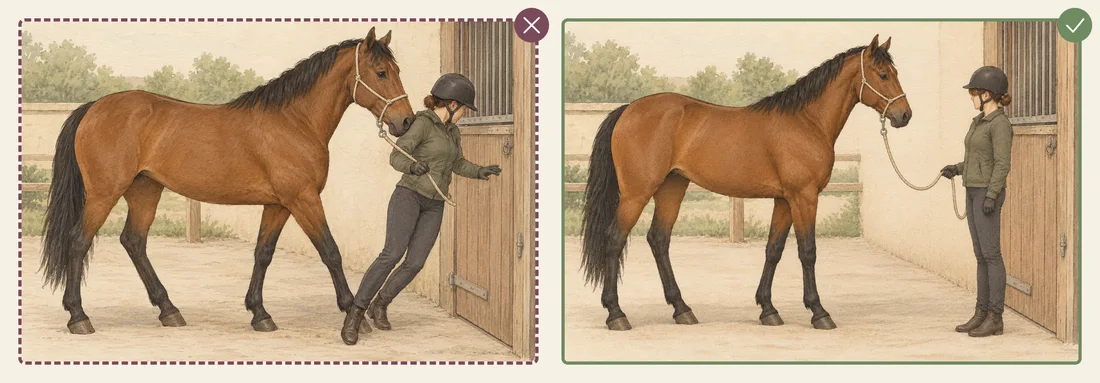
- The bubble. The space around you, which the horse does not enter without being invited. You learn to measure it, to see it, and to send him back out of it.
- The four levels. From the lightest ask, a look, to the firmest. You go up one level only if the one before was not enough.
- The release. The ask that stops as soon as the horse responds, even a little.
- The three intrusions. He comes into the bubble, he pulls, he will not move. You check them off on a sheet to know which part to start with.
The three intrusions sheet tells you in what order to work through the next parts.
Just imagine for a moment...
- Leading your horse from the pasture to his stall, his shoulder level with yours, the rope hanging in a curve.
- Opening the stall door and seeing him wait until you are inside.
- Walking past tall grass without him diving for it, or bringing him back with one gesture when he starts.
- Reaching the puddle on the path and crossing it with him, at your pace.
A halter, a rope, gloves, and the places you use every day
No special horse or arena needed: a barn aisle, a halter, a rope a little longer than usual, gloves, and the habit of looking at the horse before you touch the rope.
The book is worked with an adult horse, beside you, in front of you or behind the door, never in a circle around you. And every exercise has its safety instruction.
What this book does, and what it leaves to others
Here, the horse stays beside you, in front of you or behind the door, on a lead rope: never in a circle around you. Work where the horse goes around the person has its own manual.
The book assumes an adult horse who already knows how to be led, tied and pick up his feet. A young horse's first times are the subject of “Training Your Young Horse with Trust.”
Nothing here is done in the saddle. And if an ask your horse used to answer suddenly becomes difficult, lesson 5.4 tells you what to note down, and who to call.
I am pleased to introduce my digital book:
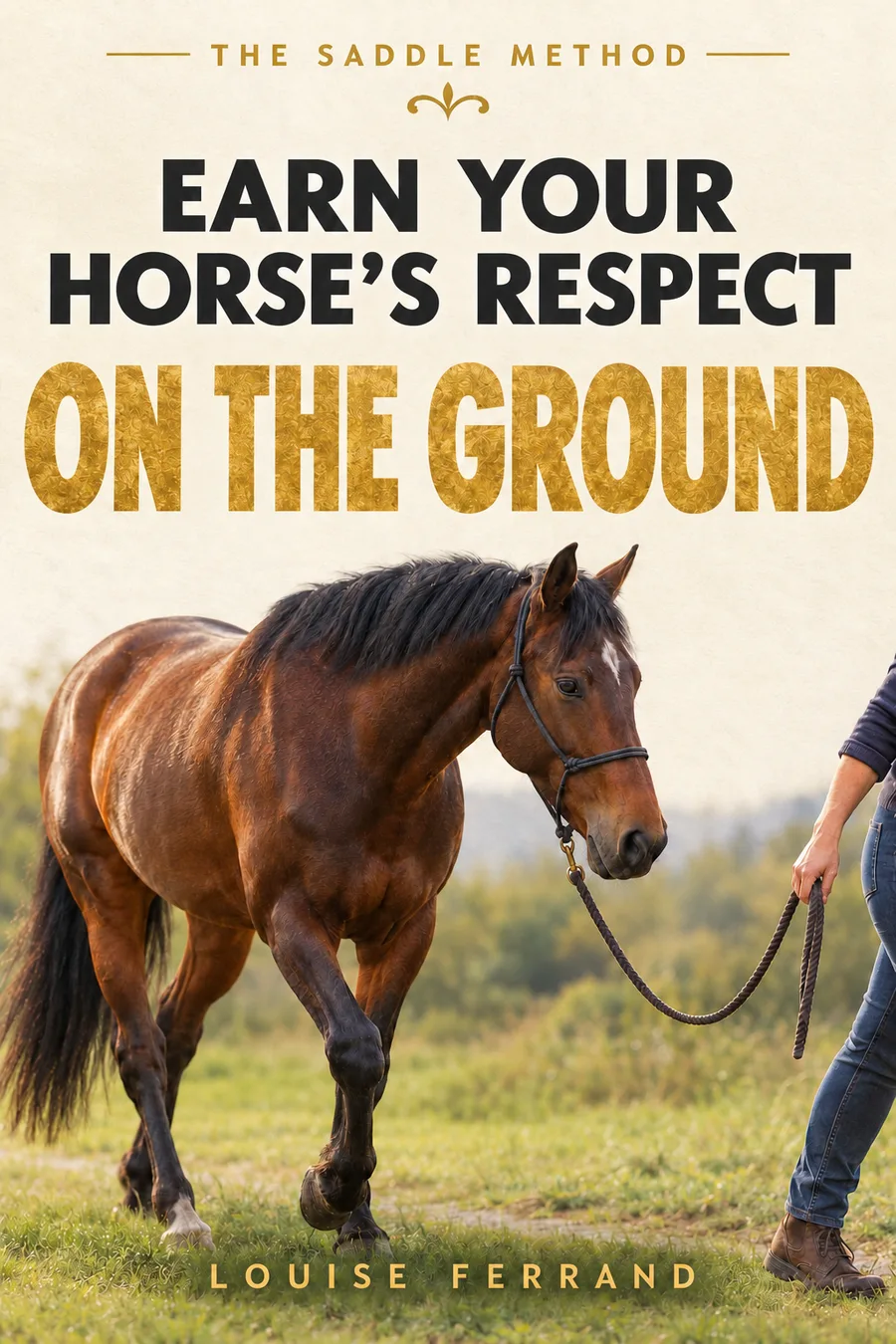
Earn Your Horse's Respect on the Ground: the space around you, light asks, and everyday life.
This book is read in seven parts and 32 lessons. Every lesson follows the same path: what happens on the ground, what to watch on the horse, the rule, then an exercise with its criterion, “You have it when,” which you check for yourself.
And it is a fully illustrated book: 94 plates over 109 pages, showing where the horse's feet are, where his head is, and what the rope is doing.
It ends with six printable sheets, including the ten-minute groundwork session.
What you will work through, part by part
Part 0 · What “respect” means here
A definition you can see, the three intrusions, the halter, the rope, the gloves.
Part 1 · The bubble
Where the bubble is, the horse who comes in, sending him back out, inviting him in, the bubble at the halt.
Part 2 · The four levels and the release
Level 1, looking, going up one level, the release, the small response that counts, coming back down.
Part 3 · Walking and stopping together
Walking side by side, the horse who gets ahead, the horse who lags behind, stopping with you, the horse who pulls toward the grass.
Part 4 · Waiting, backing up, lowering the head
Standing still and waiting, backing up from the halter, backing up from a distance, the horse who backs up crooked, lowering the head.
Part 5 · Moving the shoulders and the hindquarters
The hindquarters, the shoulders, a sidepass, and from both sides of the horse.
Part 6 · Everyday life
The stall door, the tie spot, leaving the pasture, the place that worries him, and the ten-minute groundwork session.
The six printable sheets
The three intrusions, my bubble, the four levels, left and right, in everyday life, the ten-minute groundwork session.
The gesture that changes everything fits in one sentence.
Ask first with a look.
Go up one level only if nothing moves.
And stop everything the instant he responds.
The rest of the book applies this rule to every situation.
Ready to start?
Here is everything you get today
Everything is in PDF, to read before you go get your horse, or to print so you can keep the sheets at the barn. Here is exactly what you receive:
- The complete, fully illustrated book “Earn Your Horse's Respect on the Ground” in PDF, 109 pages, 32 lessons and 94 plates (value $47)
- The bubble, the four levels and the release, set up before anything else (included)
- The stall door, the tie spot, leaving the pasture and the place that worries him (included)
- The six printable sheets, including the ten-minute groundwork session (included)
Value: $47 → today:
This price will not last: it will go back up to $47. Order today and you lock it in at $17.
Our 30-day satisfaction guarantee
I know what it is like to bring a horse in from the pasture while being dragged from one end of the path to the other. That is why I take all the risk off your side and put it entirely on mine.
Get the book today, read it, and above all do the exercises, one lesson at a time. If, after 30 days, your horse does not lead any differently, just send us an email at contact@thesaddlemethod.com. We will refund your purchase in full, no questions asked, no justification needed. And you keep the book you downloaded.
In other words: either this book moves you forward, or it costs you nothing.
P.S. Here is the summary: order today and you get the fully illustrated book “Earn Your Horse's Respect on the Ground” for $17 instead of $47. A space you can see, four levels of ask, a release as soon as the horse responds, and the everyday gestures. And if, within 30 days, the book does not help you, you get a full refund, no questions asked.
P.P.S. Remember: the $17 price will not last. The next time your horse dives for the grass, you can pull, or make the lightest ask and stop as soon as he comes back. That is all that separates a fight from a conversation.